
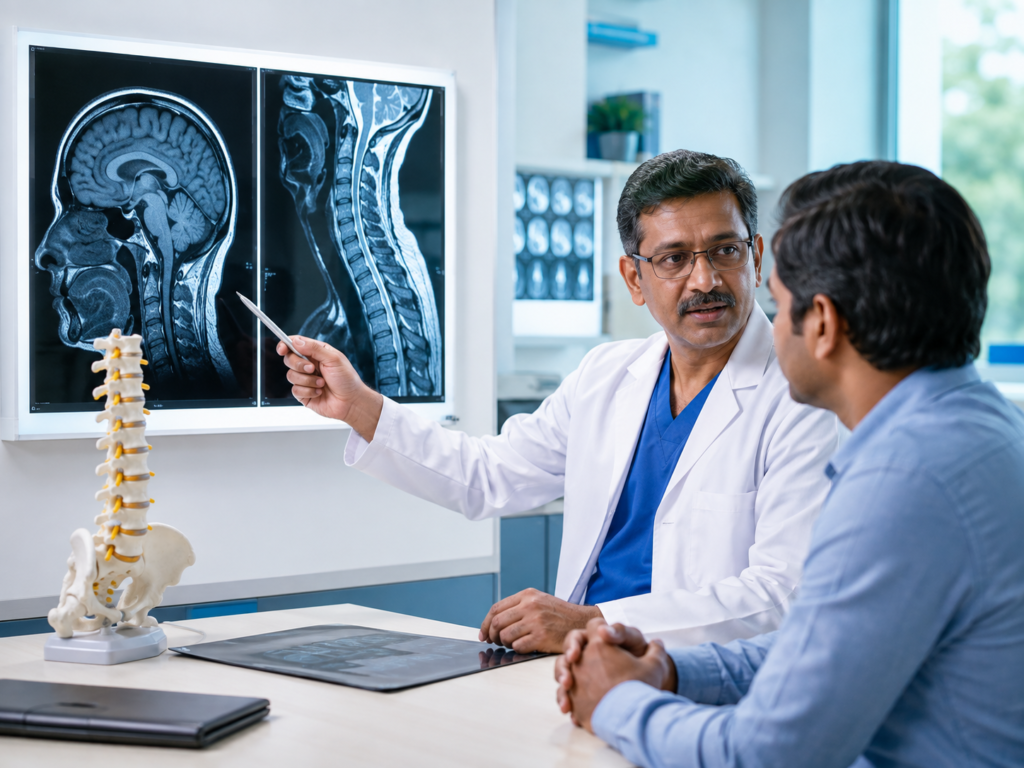

Neuro and Spine Surgery in India

India has become a leading destination for patients seeking advanced neurosurgery and spine surgery at internationally recognised hospitals. Patients can access experienced neurosurgeons, orthopaedic spine surgeons, modern diagnostic facilities, minimally invasive procedures, neuro-intensive care, and comprehensive rehabilitation.
MedIndia Tours helps international patients obtain specialist medical opinions, compare hospitals, understand estimated treatment costs, and coordinate travel to India for neurological and spinal treatment.

What Is Neuro and Spine Surgery?

Neurosurgery focuses on conditions affecting the brain, spinal cord, peripheral nerves, and supporting structures. Spine surgery treats disorders involving the cervical, thoracic, and lumbar spine, including damaged discs, compressed nerves, fractures, deformities, tumours, and spinal instability.

Treatment may involve a neurosurgeon, orthopaedic spine surgeon, neurologist, pain specialist, physiotherapist, and rehabilitation physician. Surgery is recommended only when appropriate after clinical examination and diagnostic testing.

Neurological Conditions Treated in India

Specialist neurosurgical hospitals in India evaluate and treat conditions such as:

  • Brain tumours
  • Pituitary tumours
  • Meningiomas
  • Gliomas
  • Cerebral aneurysms
  • Arteriovenous malformations
  • Hydrocephalus
  • Traumatic brain injury
  • Epilepsy
  • Trigeminal neuralgia
  • Movement disorders
  • Parkinson’s disease
  • Brain and spinal infections
  • Peripheral nerve disorders
  • Congenital neurological conditions
  • Stroke-related complications
  • Spinal cord tumours

Spine Conditions Treated in India

Spine surgery departments in India manage cervical, thoracic, and lumbar spinal conditions, including:

  • Slipped or herniated disc
  • Cervical and lumbar spondylosis
  • Spinal stenosis
  • Sciatica
  • Degenerative disc disease
  • Spondylolisthesis
  • Spinal cord compression
  • Spinal fractures
  • Spinal cord injury
  • Scoliosis
  • Kyphosis
  • Spinal deformity
  • Spinal tuberculosis
  • Spinal infections
  • Spinal tumours
  • Failed back surgery syndrome
  • Congenital spinal abnormalities
  • Chronic neck and lower-back pain


Neurosurgery Procedures Available in India

An accurate diagnosis is essential before deciding whether surgery is required. Evaluation may include:

Brain Tumour Surgery

Brain tumour surgery aims to remove as much of the tumour as safely possible while protecting important neurological functions. The approach depends on the tumour’s type, size, location, and relationship with critical brain structures.

Cerebral Aneurysm Treatment

A cerebral aneurysm is a weakened area in a brain artery. Depending on its size, location, and risk of rupture, treatment may include:

Epilepsy Surgery

Epilepsy surgery may be considered for selected patients whose seizures are not adequately controlled with medication. Evaluation may include prolonged EEG monitoring, high-resolution MRI, PET imaging, and neuropsychological testing.

Deep Brain Stimulation

Deep brain stimulation involves implanting electrodes in selected areas of the brain. It may help appropriately selected patients with Parkinson’s disease, essential tremor, dystonia, and certain other movement disorders.

Hydrocephalus Surgery

Hydrocephalus causes excess cerebrospinal fluid to collect within the brain. Treatment may involve:

  • Ventriculoperitoneal shunt surgery
  • Endoscopic third ventriculostomy
  • Treatment of the underlying obstruction

Peripheral Nerve Surgery

Peripheral nerve procedures may be considered for nerve compression, trauma, tumours, or loss of function. Treatment may include decompression, repair, grafting, or nerve transfer in selected patients.

Neuro and Spine Rehabilitation in India

Rehabilitation may begin before surgery and continue after discharge. A programme may include:

  • Physiotherapy
  • Occupational therapy
  • Gait and balance training
  • Strengthening exercises
  • Speech and swallowing therapy
  • Cognitive rehabilitation
  • Bladder and bowel management
  • Pain and spasticity management
  • Wheelchair and mobility training
  • Psychological counselling
  • Family and caregiver education

Rehabilitation goals are personalised according to the patient’s neurological condition and functional ability.


Neurology treats nervous-system conditions primarily through medicines and non-surgical care. Neurosurgery involves surgical treatment of selected brain, spine, spinal cord, and peripheral nerve conditions.


No. Many slipped discs improve with medication, activity modification, and physiotherapy. Surgery may be considered when symptoms remain severe, neurological weakness develops, or nerve compression does not respond to appropriate conservative treatment.

Modern spine surgery is generally performed with advanced imaging, anaesthesia, and monitoring. However, every operation has risks, and safety depends on the patient’s condition, procedure, and surgical complexity

The duration may range from approximately one hour for selected procedures to several hours for complex fusion, tumour, trauma, or deformity surgery.

Many patients are encouraged to stand or walk with assistance after the medical team confirms that it is safe. Timing depends on the surgery and the patient’s neurological condition.

Complete removal depends on the tumour’s type, size, location, and proximity to critical brain structures. Sometimes partial removal or biopsy is safer, followed by additional treatment.

Yes. Patients can share recent medical reports and imaging for preliminary review. The final treatment plan may change after physical examination and additional testing in India

While it’s possible to travel alone, we recommend having a friend or family member accompany you for emotional and physical support, especially during the initial recovery days. We can arrange for both of you to stay comfortably near the hospital and ensure both your needs are taken care of.

Scroll to Top